Open-air theatre is an entirely different reality: informal, open, and a little improvisational. Here, actors have to contend with their own nerves as well as the wind, the rustling of trees, and the hustle and bustle of the city. In Liverpool, this form of stage art has become more than just a complement to traditional theatre; it’s a full-fledged cultural phenomenon. What’s interesting is that it attracts not only die-hard theatregoers but also those who would typically opt for a walk in the park or a summer festival. In this article on liverpool-trend.com, we will tell you about:
- the most striking open-air performances in Liverpool;
- the formats local theatre-makers choose—from puppets to Shakespeare;
- the people behind the most outstanding events;
- how this genre is changing the very perception of theatre in the city.
So, theatre enthusiasts, get comfortable and get to know a very interesting direction of your favourite art, or rather, how it is presented in Liverpool!
Theatre Among Trees and Columns: Liverpool’s Iconic Locations
For a city where greenery often borders history, open-air theatre has become a way to rethink familiar locations. Calderstones Park, with its Garden Theatre, is an almost perfect example of an intimate outdoor stage. Here you can see classic productions in a setting that sets the mood all on its own: old trees, deep shadows, and warm lights against an evening backdrop.
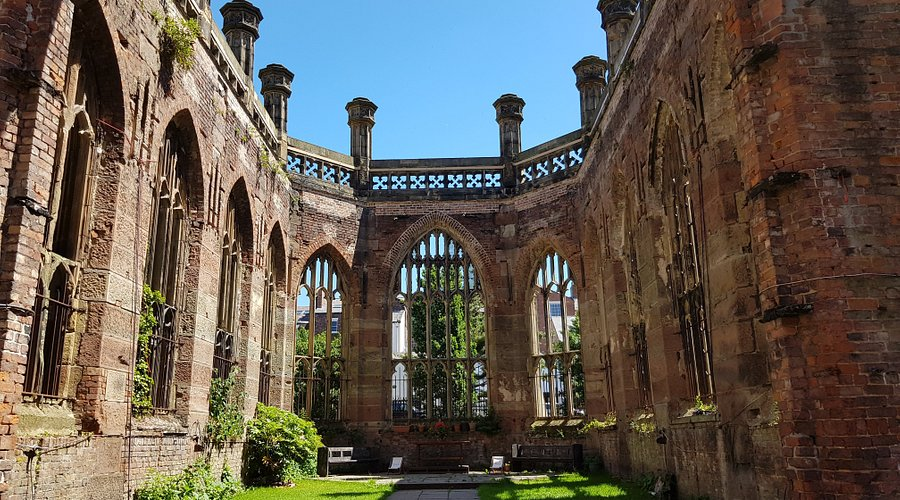
Another iconic location is the bombed-out church of St Luke’s. Half-ruined but proudly open to the sky, it has long since been transformed into an art space. Here, theatre sounds different—with an echo in the stone walls and a contrast between the ruins and the actor’s living voice.
Another style of open-air theatre can be found in historical estates and farms. For example, Speke Hall or Claremont Farm, where performances are complemented by an atmosphere of rural life and antiquity. And in Port Sunlight, in the picturesque dell between the trees, open-air shows look like a magical performance in a natural amphitheatre.
These locations, of course, embellish the show—they become full participants. At the same time, they give the audience freedom: you can sit on a blanket, you can bring a dog, you can watch from under the nearest oak instead of the front row. That’s why open-air theatre is so organically rooted here.
Giants in the Streets: How Royal de Luxe Charmed the City
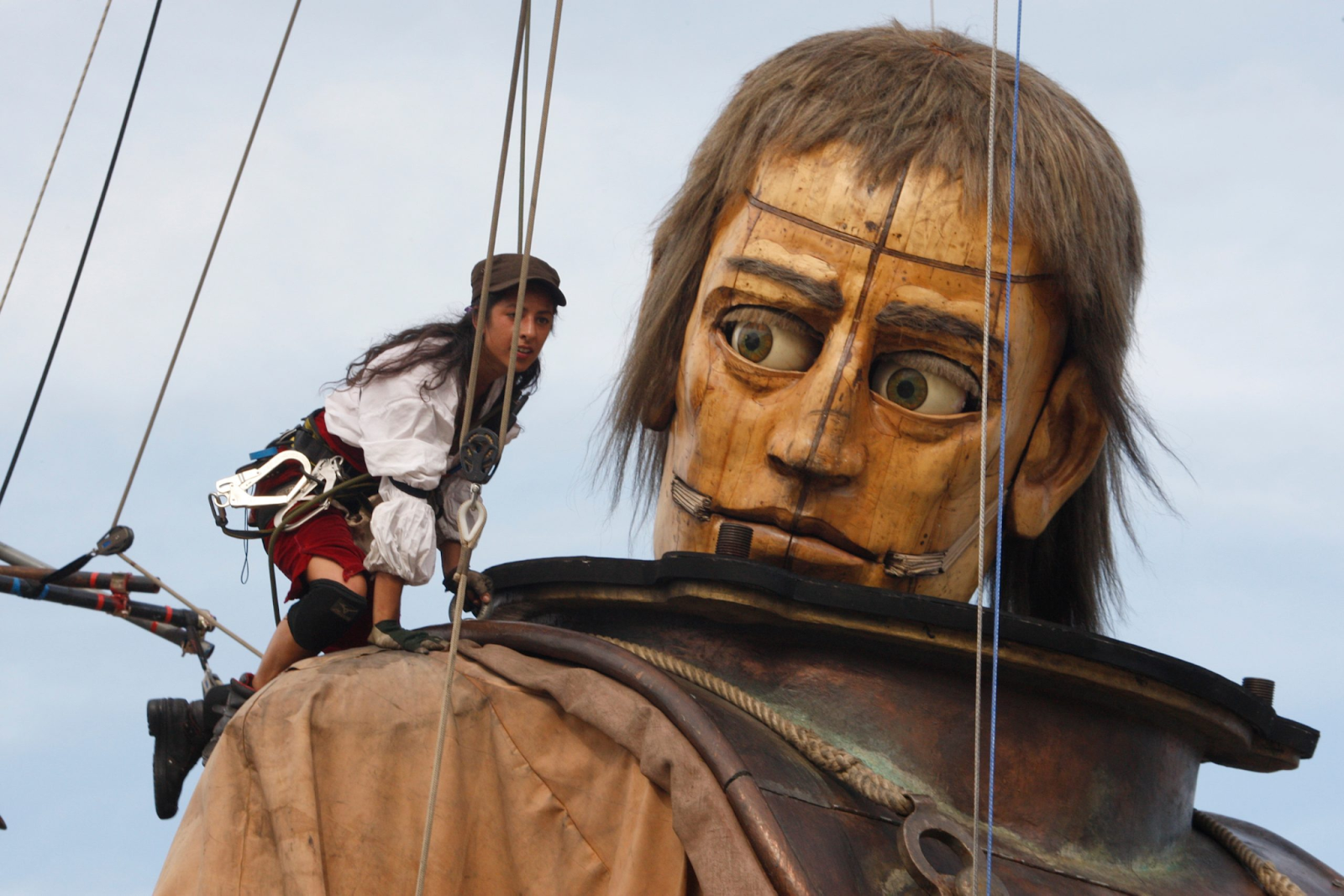
In 2014, Liverpool literally came to a halt when the giant puppets of the French company Royal de Luxe paraded through the streets. A little girl in red shoes, her diver uncle, and their beloved dog, Xolo, became the heroes of the show “Memories of August 1914,” dedicated to the centenary of the start of the First World War. For three days, more than 1.5 million people came out onto the streets of the city to see the show and experience something very important together.
Theatre, in this case, became part of the urban landscape. It’s not the stage that invites the audience, but the audience that follows the characters—through streets, squares, and ports. Royal de Luxe effectively drew the entire city into a collective emotion. People cried, laughed, and talked to strangers while the giants “slept” on green lawns or “strode” down central avenues.
This format is hard to call a classic open-air show—it is more a symbiosis of street theatre, mythology, and urbanism. But its influence on Liverpool’s theatre culture is colossal. After this, the city was finally convinced that theatre can exist not only in a hall but anywhere there is a story and a desire to tell it live.
The Reader and Theatre for the Soul: The Emotional Open-Air Format
The organisation The Reader is known in Liverpool for working at the intersection of literature, therapy, and community life. But in the 2020s, it has been actively adding another component: open-air theatre. In Calderstones Park, on the grounds of an old villa and among the gardens, a seasonal venue for intimate open-air performances has appeared. There are no fixed roles, no evening gowns, and no tickets for hundreds of pounds—instead, there are blankets, thermoses of tea, and a genuine desire to be together.
For example, the summer 2025 programme included productions based on the works of Jane Austen, Shakespeare’s plays, classic Gilbert and Sullivan comedies, as well as a family show for the little ones. The plays of the most outstanding English classic are sometimes called a Shakespeare Festival, which you can read about separately. Though some people don’t consider it a full-fledged festival like the one in Stratford-upon-Avon.
Indeed, the format here is simple: you arrive, sit on the grass, and enjoy. But it is precisely this simplicity that holds immense power. The theatre here doesn’t “perform for you” but seems to become part of a large family gathering. And yet it was called a festival, even though the scale of the event is local, not national.
The Reader sees theatre as an emotional experience—not just entertainment but a form of contact. With the text, with nature, with the people around you. And that’s why this format works especially well for those who don’t feel at home in “big” theatres, or who need a gentle, cosy atmosphere. In this sense, open-air theatre is almost a form of therapy.
Open-Air Theatre in Liverpool: Features and Significance
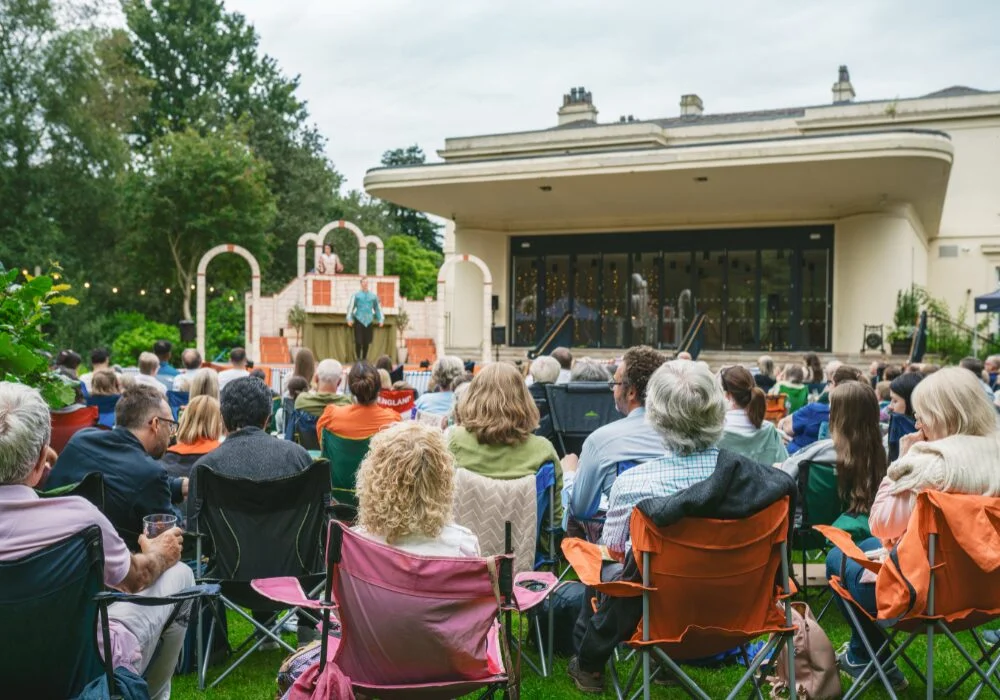
In a city that is used to bold experiments—in music, urban planning, and art—open-air theatre has become another manifestation of its openness to new things. And at the same time, it’s a return to a very old tradition: to perform for people in the open, among them, with them.
This format has its unique features.
- First, physical proximity: there is no barrier between the actor and the audience.
- Second, unpredictability: the weather, the surrounding sounds, even a dog running across the stage—all of this creates a lively dynamic.
- And third, flexibility. A show can be seen by chance while walking through the park, or it can be planned as part of a summer weekend.
Open-air theatre in Liverpool fulfils an important social function: it engages people. Entering a theatre is not always easy, but it’s perfectly fine to come with children to a clearing and listen to Shakespeare with a coffee in your hand. This is about lowering the threshold, about inclusivity, about the opportunity to be part of cultural life without any extra conditions.
And although major events like the Royal de Luxe show don’t happen every year, they are the ones that shape the idea that theatre is not a place, but an action. And an action, as we know, can happen anywhere—you just have to leave the house.
The Audience as a Co-Author: What Makes Open-Air Theatre Special
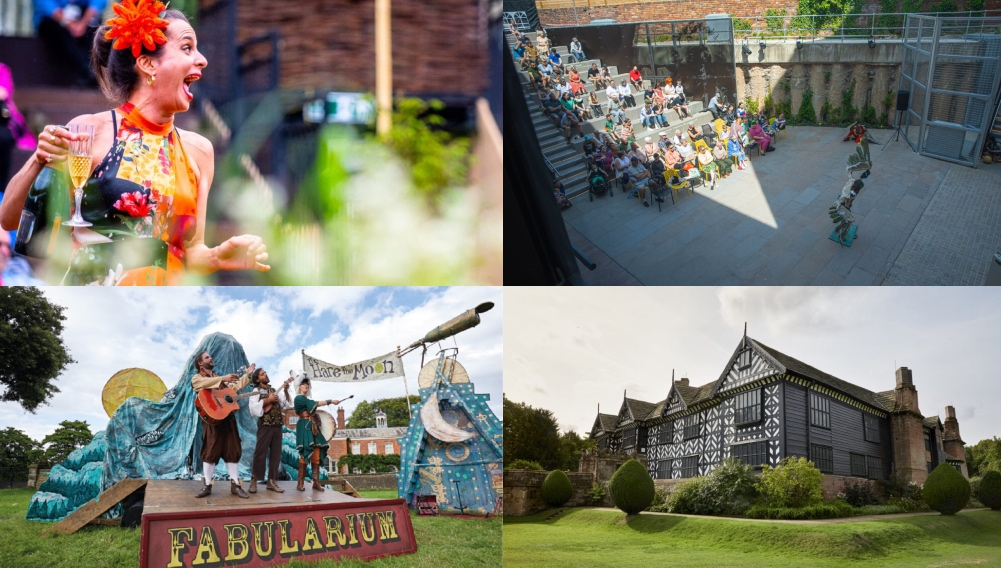
In traditional theatre, the audience is a silent observer. They sit in the dark and listen attentively, afraid to move. In an open-air show, everything is different—there is more freedom. A facial expression, an open laugh, a child’s question out loud, or unexpected applause at an unusual moment—all of this becomes part of the performance. Here, the audience, with its reactions, can be said to be co-writing the script. And that is why each performance is unique in its own way.
Actors often adapt to the circumstances: someone improvises when the wind blows their hat off, someone interacts with the audience member sitting closest. Sometimes, the audience becomes part of the stage without even planning to. And this natural interaction creates a kind of informal connection. The audience leaves with the feeling that they didn’t just watch a performance—they feel like they were a part of it.
Open-air theatre in Liverpool is not just an event on a poster, but an experience. It doesn’t require elaborate scenery or a closed hall. All you need are people, a story, and a little bit of space. And when you see an exciting performance with a piece of sky as your roof, isn’t that the true magic of art?